Frequency-Modulated Piezoelectric Haptic Display
Shared Source Frequency Modulation
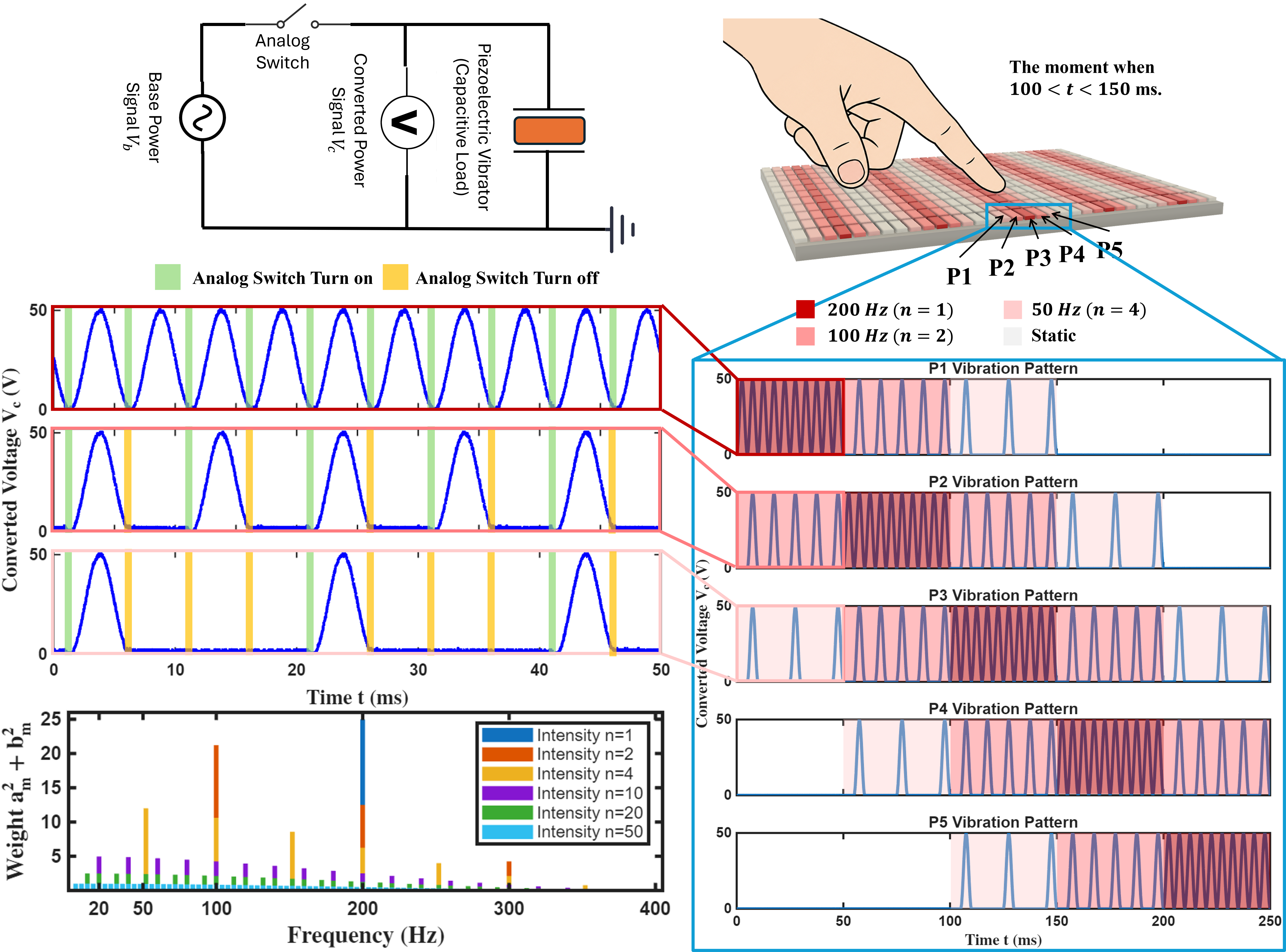
Overview of the SSFM structure.
Upper Left: Schematic of a single pixel, powered by the shared base signal and gated by an analog switch.
Upper Right: Temporal relation among the base waveform, the analog switch action, and the converted waveform. To produce a nominal frequency of 200/n Hz, the switch is opened for n-1 base periods and then closed again for one period.
Lower Left: Spectra of the converted waveform for selected pixel intensities n=1,2,4,10,20,50.
Lower Right: Example of how dynamic haptic patterns are generated by SSFM, where darker shading denotes a higher nominal frequency.
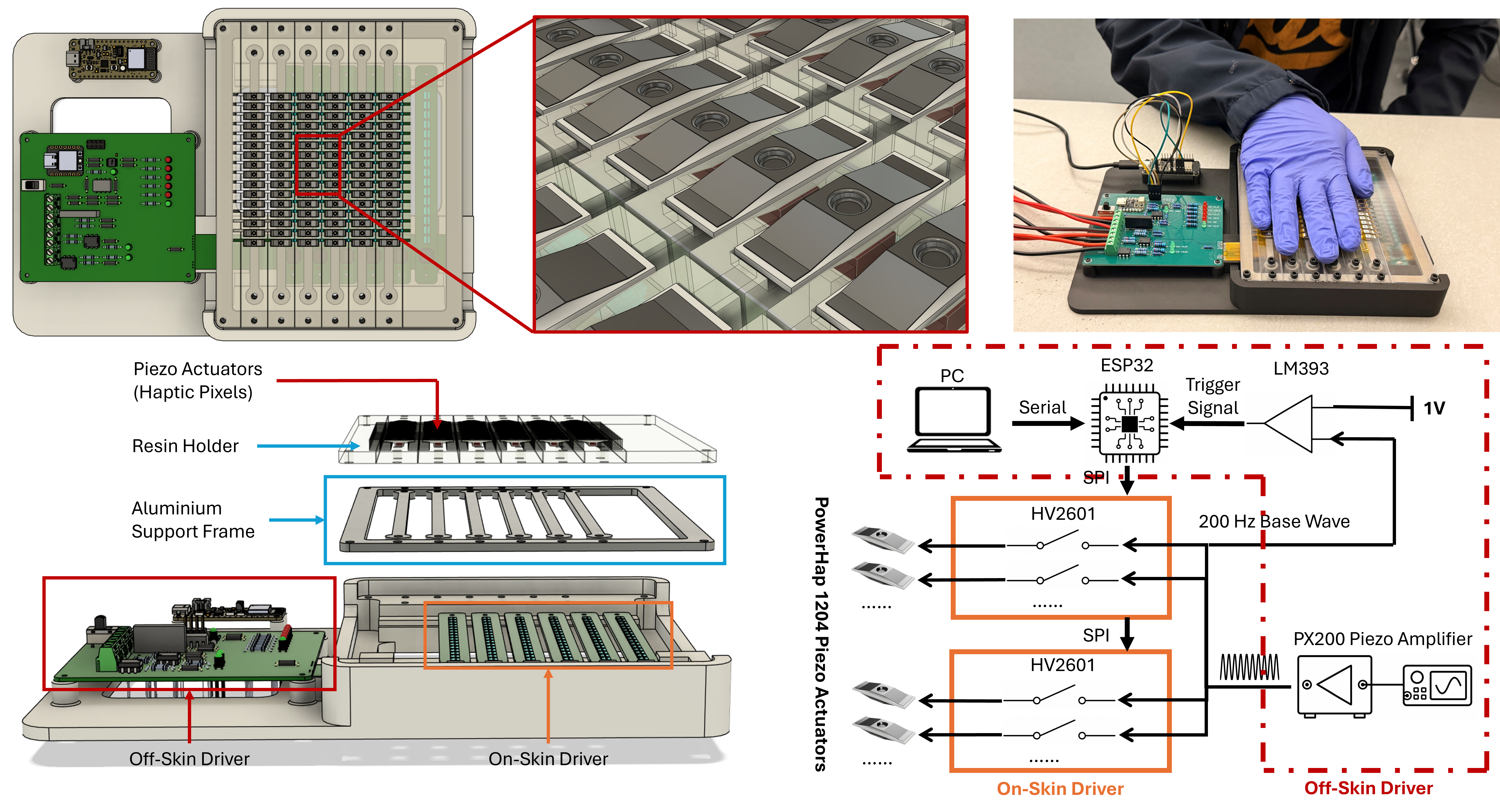
Implementation of the proof-of-concept prototype.
Upper left: Top view of the assembled display.
Upper middle: Close-up of the display surface.
Upper right: Snapshot of a human-participant experiment.
Lower left: Exploded view of the prototype. The piezoelectric actuators are mounted on photo-cured resin holders, with aluminum support frames beneath to limit deflection of the holders under hand pressure.
Lower right: Schematic of the electrical connections. The ESP32 microcontroller sets the state of each analog switch channel over a high-speed SPI link, while the host PC streams haptic display frames to the ESP32 over a serial connection.
Experiment Results
Volunteer tests conducted with 11 participants, 8 male and 3 female. Results show that this frequency-modulated (FM) design can effectively deliver haptic patterns.
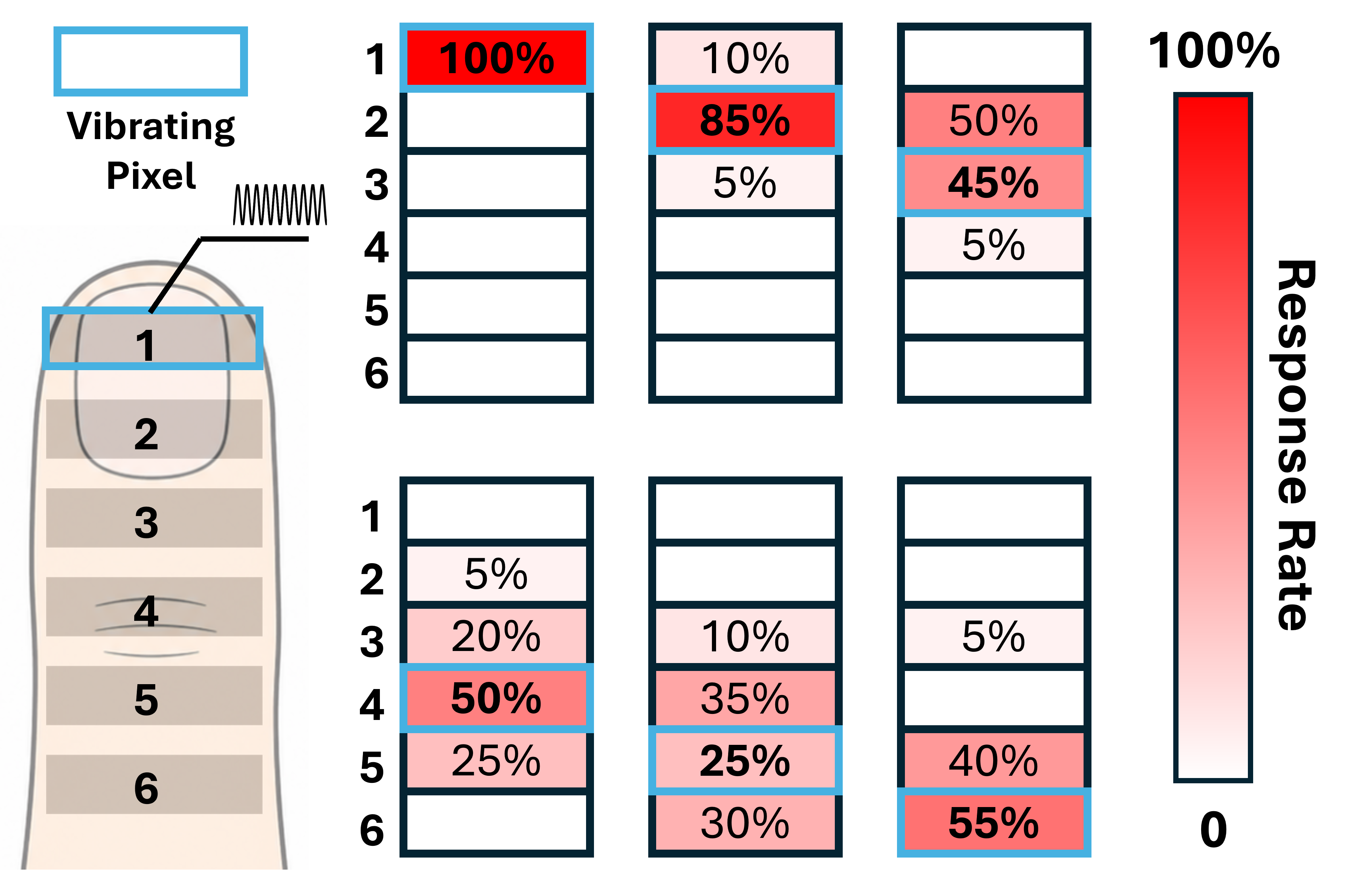
Experiment 1: identification of vibration position along the index finger. Each block corresponds to one stimulated pixel, outlined in blue, and its entries give the distribution of reported positions.
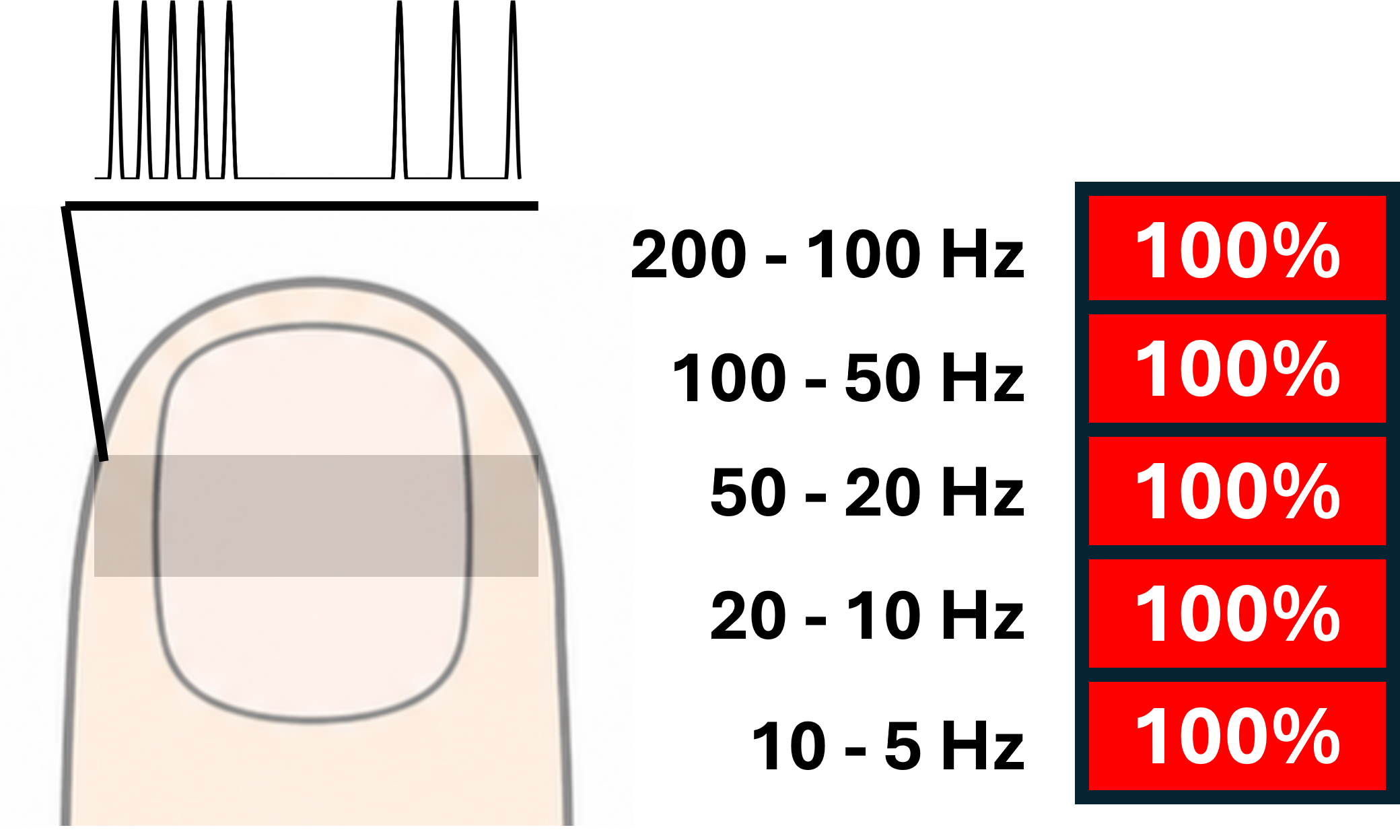
Experiment 2: discrimination of vibration intensity. Participants reported which of two successive vibrations had the higher nominal frequency.
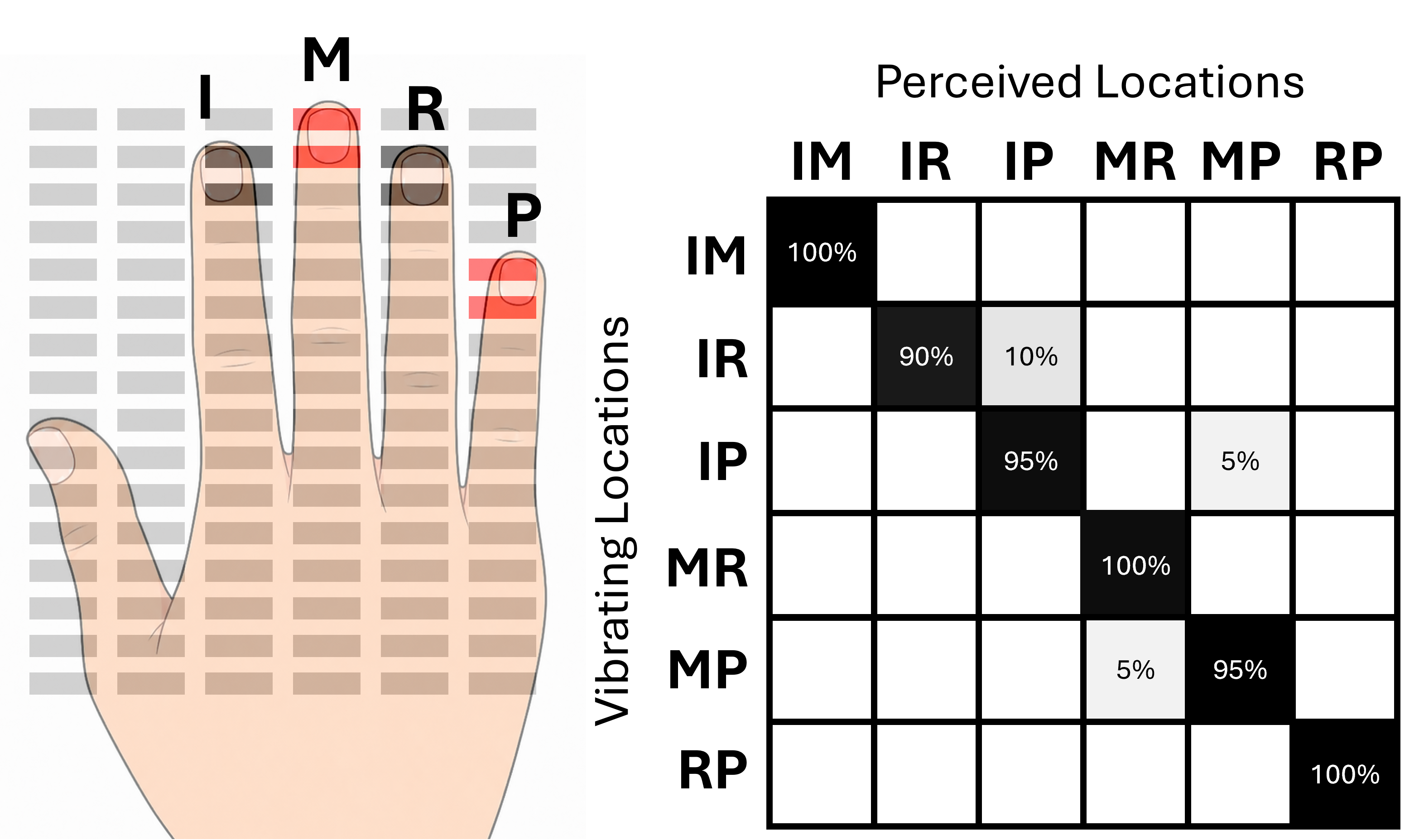
Experiment 3: multi-finger vibration perception. Participants reported which two fingers were stimulated, denoted index (I), middle (M), ring (R), and little (P).
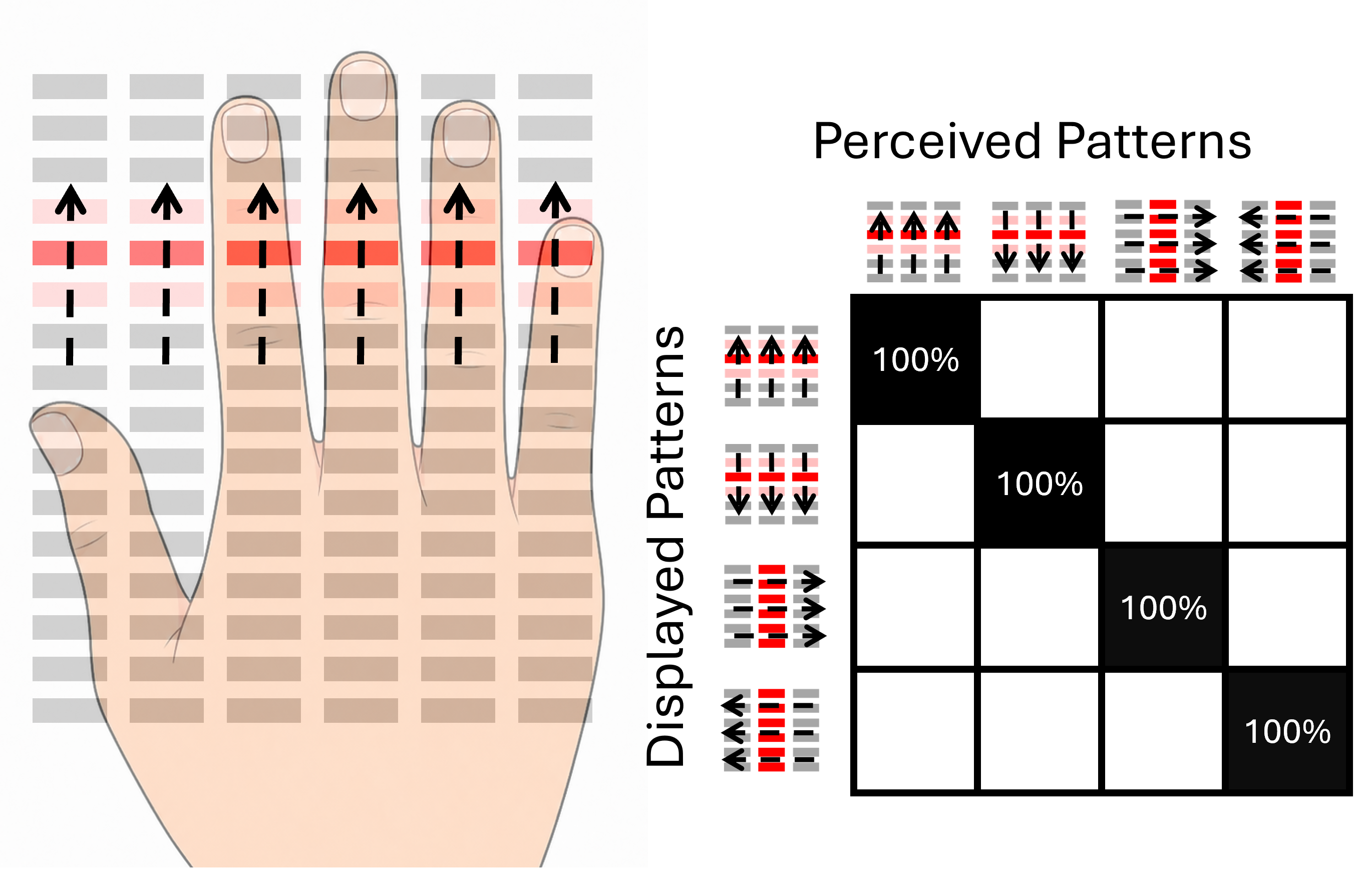
Experiment 4: perception of linear motion patterns among the up, down, left, and right directions.
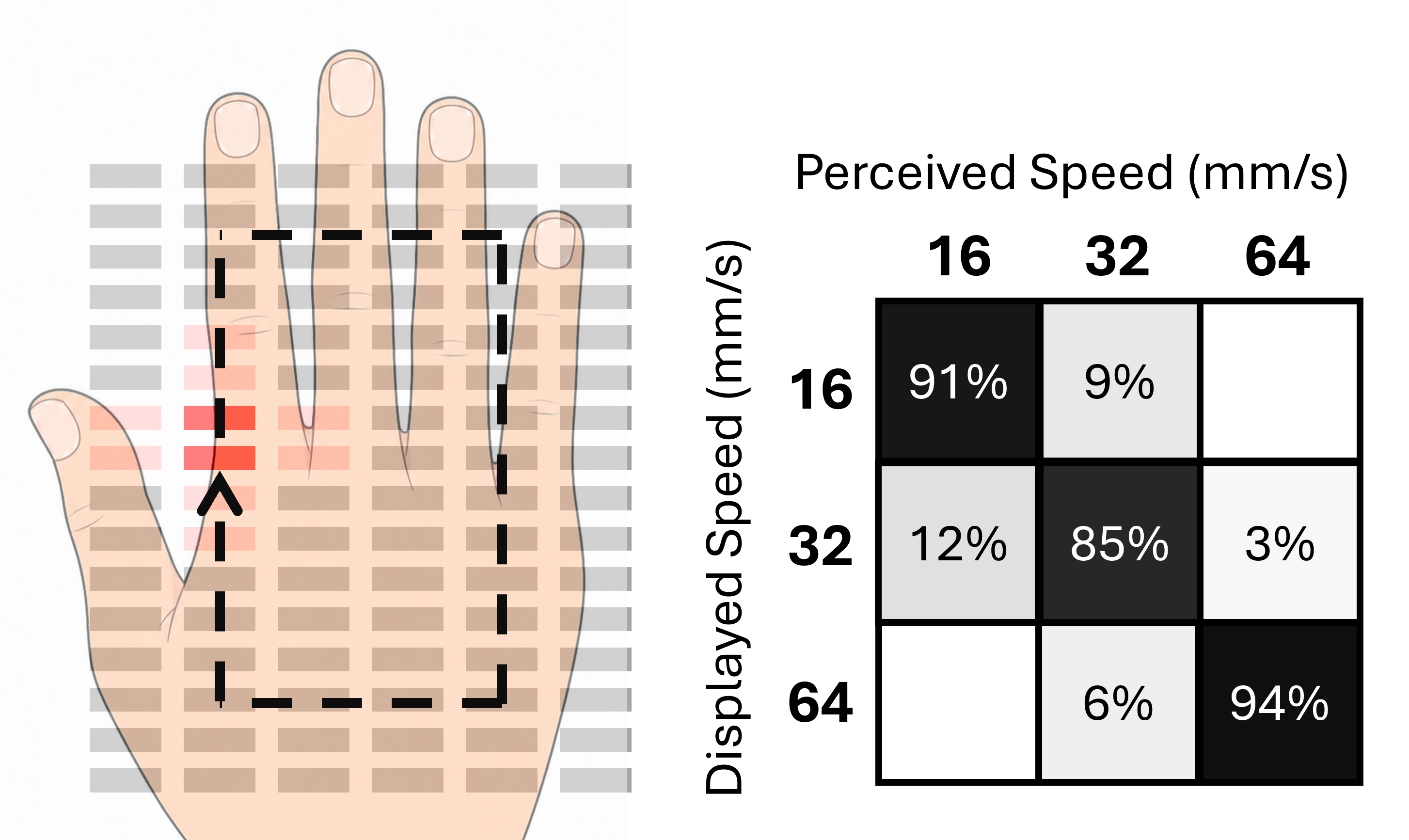
Experiment 5: perception of rotational motion speed among 16, 32, and 64 mm/s
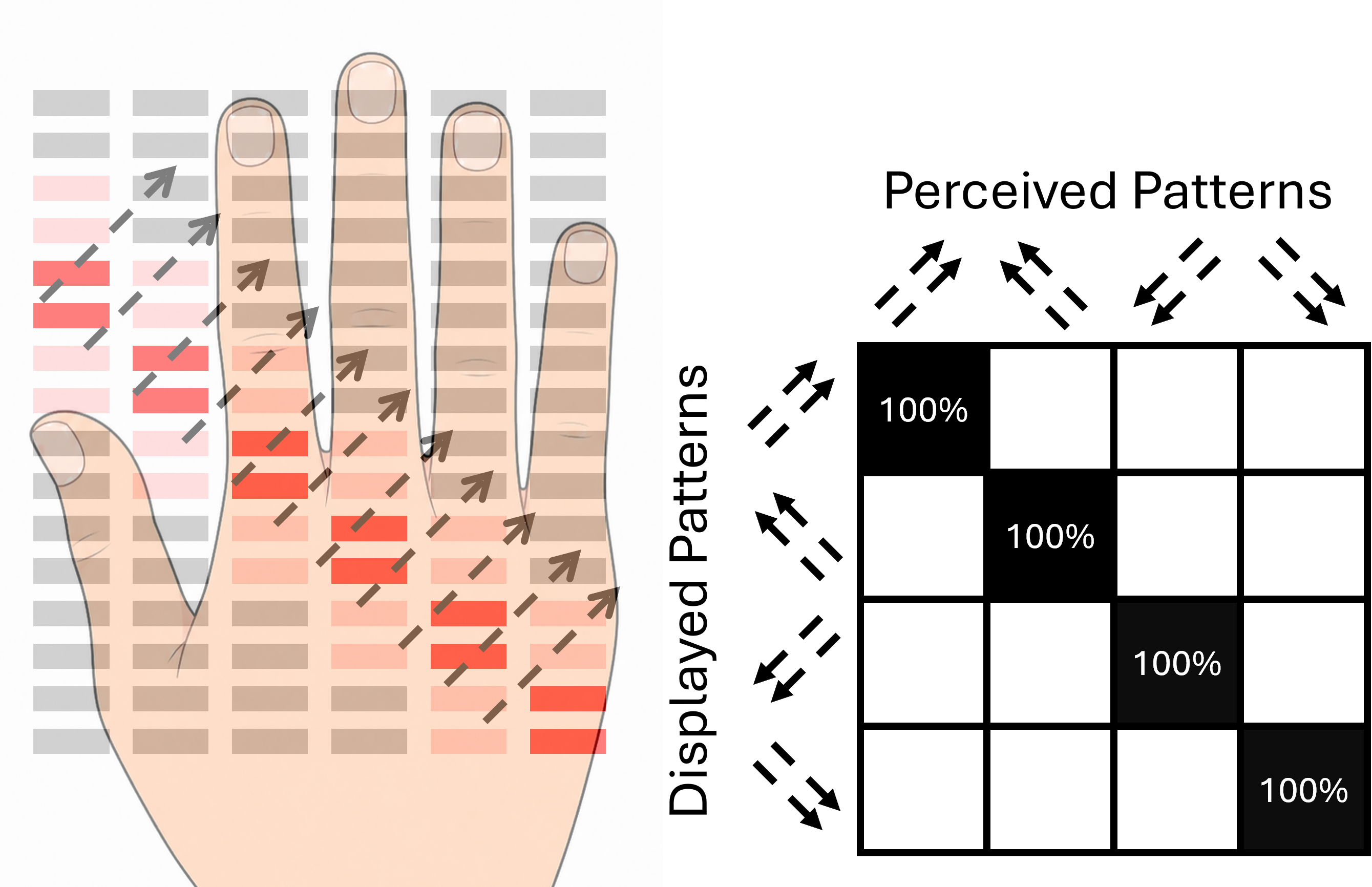
Experiment 6: perception of linear motion patterns among the four diagonal directions.
Future Work
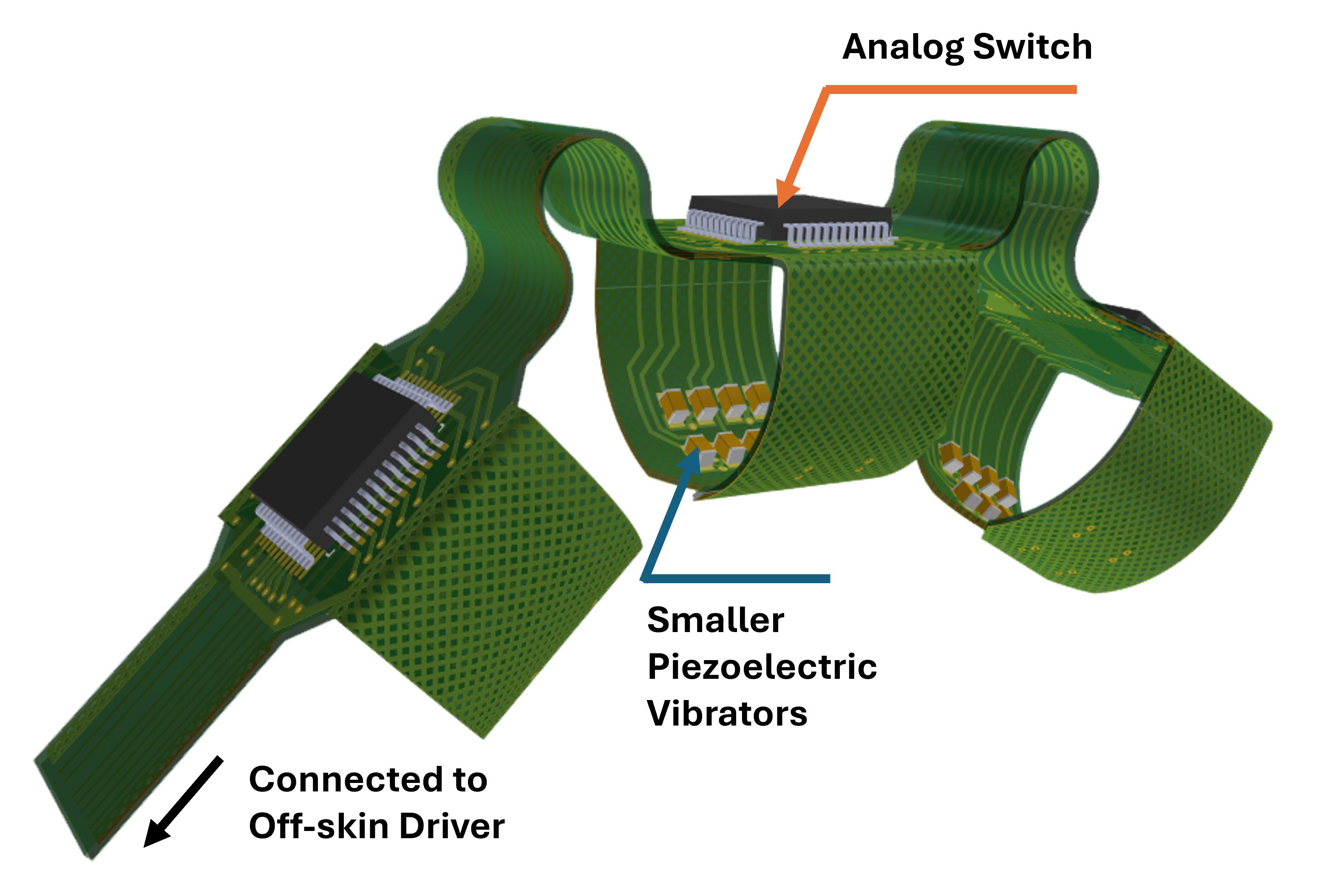
Based on the theoretical foundation of this work, our immediate next step is building a haptic glove with large pixel sizes. On the left is a rendering of the wearable haptic device on one finger.
BibTeX
@article{liang2026frequency,
        title={Frequency-Modulated Piezoelectric Haptic Display},
        author={Boyuan Liang and Lingfeng Sun and Masayoshi Tomizuka},
        journal={arXiv},
        year={2026}
      }